
All generators send out energy in the form of electrical power, and they have to be given the equivalent mechanical energy. This means that they have to be driven...
Transfomers

Transformers are one of the electric machines as it depends on the same basic principles of magnetic fields. And because it has not any movement, it is called stationary electric machines. It is the equipment that converts electric power to electric power but with another voltage and current level.
Its importance can be cleared at power transmission systems and how it will be if we used the generated voltage as it is. Also, for using huge varieties of electric appliances such as high voltage motors, electric heaters, lighting loads and control devices. For that we can’t use a unique voltage level.
Transformer can be specified with the following data:-
-Rated apparent power KVA
-Rated primary voltage KV
-Rated secondary voltage KV
-Rated frequency Hz
-Efficiency %
-Number of phases 1ph or 3ph
-Insulation class letter
-Transformer type Oil/ Dry
-Cooling method Letters
-Connection group Letters
-Installation Indoor/Outdoor
-Maker
-Origin
Theoretical background
Transformer is an electrical device consisting of two or more coils, which are inductively coupled to transfer energy from one winding to another. A basic transformer is shown bellow (figure 2.1). It is made up of two windings, primary and secondary windings. These windings are positioned so that the magnetic flux produced when a current is passed through the primary windings will induce a voltage and current flow in the secondary windings. Thus, if the primary winding is connected to an AC source, an alternating magnetic flux is produced in the secondary winding. The energy going into the primary winding has, therefore, been transferred to the secondary winding through electromagnetic induction. This energy transfer is always made without a change in frequency
The amount of voltage produced in the secondary windings depends on two factors:-
– The strength of the magnetic flux;
– The number of turns of the secondary coil.
The strength of the magnetic flux is determined by the number of turns of the primary coil and the type of core material. Because the core material does not usually change, the output of transformer depends on the ratio of the primary to secondary windings. This commonly called the turn’s ratio
Voltage Ratio
The voltage ratio of an ideal transformer depends upon the ratio of the number of turns on the primary and secondary windings. The relationship is
E1 = N1
E2 N2
Where:
E1: is the primary voltage, in volts (V)
E2: is the secondary voltage, in volts (V)
N1: is the number of primary turns
N2: is the number of secondary turns.
This equation holds true when the secondary winding is on open-circuit, and when the coils are closely coupled.
The primary and secondary windings are said to be closely coupled when the flux produced by one coil is almost entirely captured by the other coil. Coils are closely coupled when they are very close together. Ideally, the primary and secondary coils should be wound on top of each other. If the coils are far apart, they are loosely coupled. Under these conditions, only a fraction of the flux produced by the primary winding is captured by the secondary winding. As a result, the secondary voltage may be considerably less than that given by the former equation. The flux created by the primary winding which does not enter the secondary winding is called leakage flux
Transformer construction
Based on Transformer theory it must have the following contecnts:-
– Iron core,
– winding (copper/Aluminum (primary and secondary windings).
– isolation media (oil, air, liquid, resin)
– tap changer (on load/ off load)-if any
– Enclosure (if any)
– Breather (silica jil)
and we hope to talk about transformers (special designs, abnormalities, ….etc) with more details in coming articles
Smart Solutions
Other articles

Electric Power Generation

Generator Protection
Generator protectionAutomatic circuit breaker is the first protection for the diesel generator against overload and short circuit faults; while it can be embedded with other protections for ground fault,...
18th pulse transformers
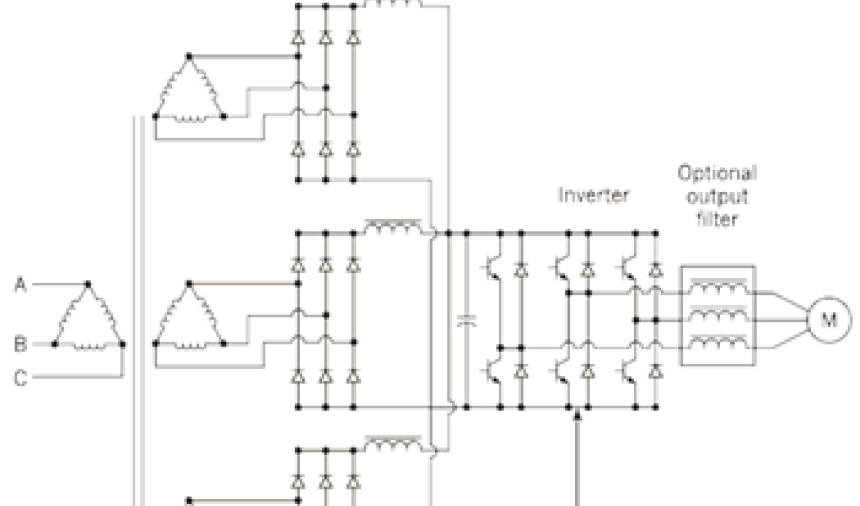
18th pulse transformersThe power transformation theory (Magnetic circuitry) is used in many special applications in order to gain more quality, stability and avoid more cost or more waste. One...
CONTACTORS UTILISATION CATEGORIES
Contrary to popular belief, Lorem Ipsum is not simply random text. It has roots in a piece of classical Latin literature from 45 BC, making itIn order to qualify...